
In the Orthodox Church the Easter Feast is officially called Pascha, which means “Passover,” and it remembers the new and everlasting covenant foretold by the prophets, which was fulfilled by Christ’s Resurrection. Pascha is the major feast of the Orthodox Liturgical year, and is a time of exultant joy and celebration, because Christ has broken the power of death! Let's learn some more about what Pascha is and how it is celebrated.
Pascha
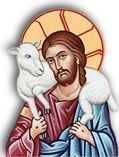
Originally, the word “Pascha,” or “Passover,” referred to the events recounted in Exodus 12, where a lamb was slain in each household and its blood sprinkled on the lintel and doorposts of the house, so that when all the first born in Egypt were slain the angel of death would pass over these houses. This is the event remembered at the Jewish Passover. The fulfilment of the Jewish Passover in Christ has made Him, for Christians, the “Paschal Lamb.”
In the Christian context Pascha signifies a passing over from death to life, from earth to heaven, a day of victory, the Day of the Kingdom of God. With heart-felt meaning, these words are sung during Pascha:
This is the day which the Lord has made, let us rejoice and be glad in it!
Easter is the Feast of Feasts, celebrated by the church with special solemnity. The lights, flowers, and vestments all denote the flood of joy and grace, which proceed from the Resurrection of the Saviour.
The celebration
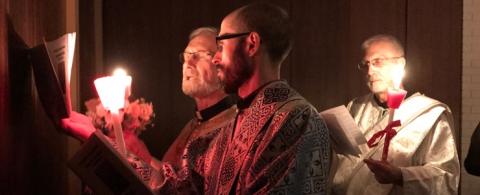
The service begins a little before midnight on the eve of Pascha Sunday. The Church is darkened — with no lights or candles — and the Priest, standing before the Holy Altar, lights a white candle and chants or sings these words:
Come, receive the Light from the Light that is never overtaken by night and glorify Christ Who is risen from the dead.
This prompts the congregation to light their candles from the Priest’s, and then to use their lit candle to light the candles of those around them. The people then file out of the church building and walk around it while singing:
The angels in heaven, O Christ our Saviour, sing of Your resurrection. Make us on Earth also worthy to hymn You with a pure heart.
The doors are closed behind the people, and once they have reassembled in front of the church doors the resurrection of Christ is announced. The gospel is read which tells of the empty tomb. The Paschal troparion is sung, the first of many times this song is sung:
Christ is risen from the dead, trampling down death by death, and upon those in the tombs bestowing life!
The Priest knocks loudly on the church door for re-entry, and shouts to the “gate-keeper” — a person on the inside of the doors, designated to fulfill the re-enactment of this scene — saying “Lift up your heads, O ye gates, that the King of glory may come in,” and the gate-keeper asks “who is this King of glory?” The Priest answers “the Lord strong and mighty, the Lord mighty in battle... the Lord of hosts, he is the King of glory!”
At this point — when it’s midnight — the lights in the church are all turned on. The doors are opened, and the people file back into the church while singing joyously. Most of the rest of the service will be sung, and regular shouts of “He is risen” and replys of “Truly, He is Risen!” is heard in many languages thoughout the night. The Easter Icon is prominent showing Christ destroying the gates of hell and freeing Adam and Eve from the captivity of death. It is the image of the Victor “trampling down death by his own death.” The triumphant words are sung:
It is the day of Resurrection, O people, led us be radiant. Pascha, the Pascha of the Lord; for Christ God has brought us from death to life, and from earth to heaven as we sing the triumphal hymn.
Towards the end of the Easter service the famous Pascha Homily of St John Chrysostom is read*. This sermon is an invitation to all the faithful to forget their sins and to join fully in the feast of the Resurrection of Christ, the Passover Lamb. Following this, some parishes will partake of the Eucharistic gifts.
The response at the end of the service from the congregation is explosive — “Christ is Risen” — and the season of joy has begun! After the service, eggs that are dyed red are handed out, in remembrance of a miracle performed the first Pascha, when Mary Magdalene brought the news of Christ’s resurrection to the Emperor Tiberus Caesar, who scoffed and said that Christ had “no more risen from the dead than eggs are red,” and immediately a nearby basket full of eggs turned red.
The night is concluded with a feast. This marks the end of the Lenten fasting period, and so many rich and delicious foods will be seen here — foods that may not have been eaten in more than a month. This marks the beginning of Bright Week, a week of feasting and celebrations of Christ’s resurrection.
The Paschal season continues until Pentecost. This is a joyous time in the Church. The people greet one another with the words “Christ is Risen!” and respond with “Truly, He is Risen!”
Learn More
See photos from Pascha at The Good Shepherd from 2017.
*The Easter Homily of Saint John Chrysostom
If any be a devout lover of God, let him partake with gladness from this fair and radiant feast.
If any be a faithful servant, let him enter rejoicing into the joy of his Lord.
If any have wearied himself with fasting, let him now enjoy his reward.
If any have laboured from the first hour, let him receive today his rightful due.
If any have come after the third, let him celebrate the feast with thankfulness.
If any, have come after the sixth, let him not be in doubt, for he will suffer no loss.
If any have delayed until the ninth, let him not hesitate to draw near.
If any have arrived only at the eleventh, let him not be afraid because he comes so late.
For the Master is generous and accepts the last even as the first.
He gives rest to him who comes at the eleventh hour in the same way as to him who laboured from the first.
He accepts the deed and commends the intention.
Enter then, all of you, into the joy of our Lord.
First and last, receive alike your reward.
Rich and poor, dance together.
You who have fasted and you who have not fasted, rejoice today.
The table is fully laden: let all enjoy it.
The calf is fatted: let none go away hungry.
Let none lament his poverty; for the universal kingdom is revealed.
Let none bewail his transgressions; for the light of forgiveness has risen from the tomb.
Let none fear; for the death of the Saviour has set us free.
He has destroyed death by undergoing death.
He has despoiled hell by descending into hell.
Hell was filled with bitterness when it met you face to face below; filled with bitterness, for it was brought to nothing; filled with bitterness, for it was mocked; filled with bitterness, for it was overthrown; filled with bitterness, for it was put in chains.
It received a body, and encountered God.
It received earth, and confronted heaven.
O death, where is thy sting?
O hell, where is your victory?
Christ is risen, and you are cast down.
Christ is risen, and the demons are fallen.
Christ is risen, and the angels rejoice.
Christ is risen, and the tomb is emptied of the dead;
For Christ, having risen from the dead, is become the firstfruits of those that have fallen asleep.
To Him be glory and power forever and ever. Amen.