
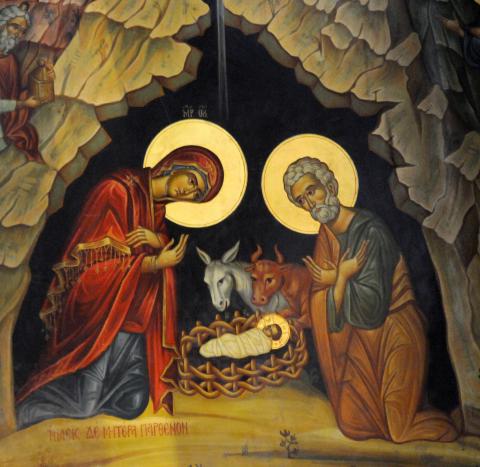
The word Advent comes from the Latin Adventus which means “coming.” In the Church calendar Advent refers to the coming of Christ, and is the ecclesiastical season just before Christmas. Advent commences two weeks prior to the Nativity of Christ (Christmas), and is commonly referred to as the “Nativity Fast.” On these two Sundays we are reminded of the Holy Ancestors of God and the Holy Fathers, Patriarchs, and Prophets who played a role in the coming of the Messiah. In the hymns of the Sunday cycle of services, we hear of their great faith and are called to build our own. Let's learn some more about the focus of Advent.
The focus of Advent
Most of us want the days to rush by because we are anxious to get to the feast! Our preparation usually consists of shopping and decorating, not to speak of the endless parties that we are invited to attend. Here is where the notion of waiting comes into play. We must discipline ourselves through self control and patience. We are to read the Scriptures, specifically the prophecies that speak of the coming of the Messiah. We are to turn our focus to a Godly way of life that calls for sacrificing and almsgiving (acts of mercy). Let us think of charity and the giving of our time, talents, and resources to others that may be in need. There is no better way to imitate Christ than to be loving and charitable towards others.
A word to the wise — put Christ back into Christmas. Find the meaning of the feast by understanding the importance of the Son of God taking on human flesh. Remember the real reason for the season is that Jesus, the Son of God, the Messiah, came into the world and dwelt among men, taking on Himself the sins of the world so that we might have life in Him.
God is with us! Understand O nations and submit yourselves, for God is with us!
(Isaiah 8:9)
The season is observed as a time of expectation, of looking forward to the coming of Christ. There is, however, a double theme as it reminds us to also look forward to the Second Coming of Christ as Judge at the last day. So the season represents both the pre-Christian world awaiting the birth of Jesus at Bethlehem and the Christian world awaiting the return of Christ in glory.
“Jesus, the world’s True Light” is a theme that runs through the whole of Advent. These are some of the themes which are studied over the course of the pre-Christmas season:
- Be ready for Christ’s return by living as He meant us to live, so that when He comes we can greet Him with joy.
- Prepare our lives for Christ to build on, a time for repentance and self-examination for greater fruitfulness.
- Joyfulness and rejoicing and an attitude of thankfulness because of the love of God.
- Mary was prepared in perfect obedience to become the Mother of Christ, through her God took on human nature and the way was opened for our salvation. Mary’s ready response to the Angel Gabriel teaches us how to react to God’s calling.
- God’s great sign of love is that Christ was carried through a human pregnancy, and so fulfilling prophecy. God is now personally amongst us.
- God is with us.
Advent is a season of great joy as well as a spiritual pilgrimage towards celebrating the Incarnation. It is a season for loving others and for almsgiving. The emphasis on “feasting” is saved for the Nativity Feast and the 12 days following (“The 12 days of Christmas”) — that is, as far as we can manage it in our society! (We all admit that we have to allow for some flexibility.)
During Advent, there is always a mixture of joyful anticipation as well as spiritual preparation.
Learn More
- About the Nativity of Christ and Advent
- 10 ways to put Christ back into Christmas
- Why Christmas is not Pagan